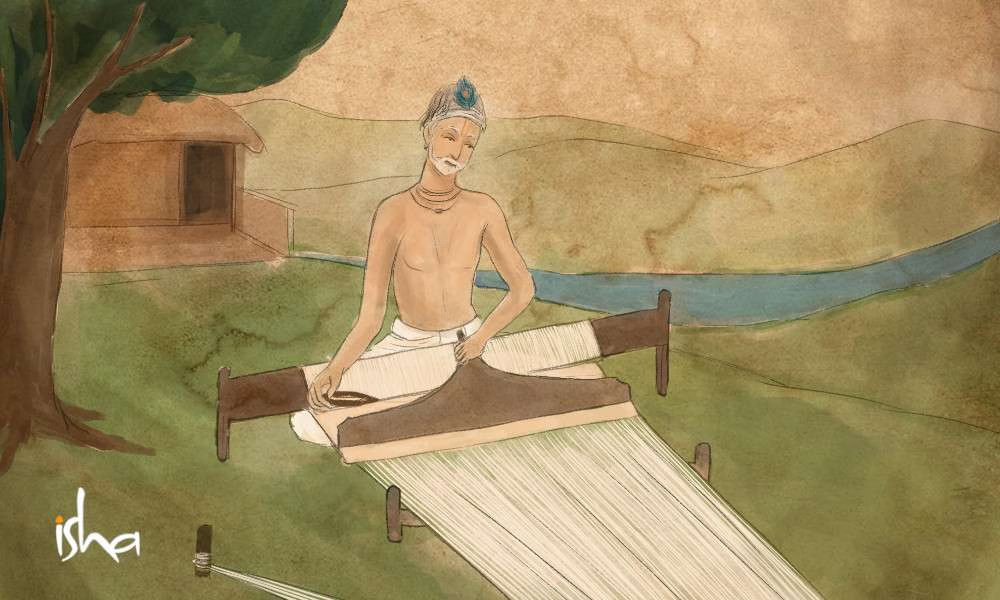
The Essence of Experience: Kabir's Call to Truth
Kabir, the revered poet-saint of the Bhakti movement, asserts that true wisdom arises from personal experience, rendering all other forms of knowledge as mere illusions. His declaration, "Kabir gives utterance to the words of experience; and he knows very well that all other things are untrue," invites us to reflect on the nature of truth and the profound insights that emerge from lived encounters. In a world saturated with information, Kabir's wisdom challenges us to discern the authentic from the superficial, urging us to seek deeper understanding through our own journeys.
This call to experience over mere belief resonates deeply in our contemporary lives, where opinions often overshadow personal truths. Kabir's words remind us that while doctrines and teachings can guide us, it is through our own encounters with life that we truly grasp the essence of existence. The urgency of this message lies in its capacity to liberate us from the confines of dogma, encouraging us to embrace the raw, unfiltered experiences that shape our understanding of reality.
The image / the metaphor
The imagery in Kabir's quote evokes a sense of clarity and conviction. The phrase "gives utterance to the words of experience" suggests a deep, almost primal connection to the truth that transcends intellectual understanding. The verbs chosen—"gives utterance"—imply an active, dynamic process of expressing what has been deeply felt and understood. This contrasts sharply with the notion of "all other things" being "untrue," which paints a stark picture of the world as a place filled with illusions, distractions, and falsehoods that can lead us astray.
Diving deeper into the metaphor, we can see that Kabir positions experience as the ultimate teacher. This perspective invites us to consider the transformative power of our encounters with life, suggesting that wisdom is not merely a collection of facts or beliefs but rather a living, breathing entity that unfolds through our engagement with the world. In this light, experience becomes a sacred journey, a path that leads us toward a more profound understanding of ourselves and our place in the cosmos.
In the speaker's tradition
Kabir's insights are deeply rooted in the Bhakti tradition, which emphasizes personal devotion and the intimate relationship between the seeker and the divine. Central to this tradition is the concept of bhakti itself, which encourages a heartfelt connection to the divine through love and surrender. Kabir's assertion that experience is paramount aligns with the idea of prajna, or wisdom, which is cultivated through direct engagement with the divine rather than through mere intellectual pursuits. This approach resonates with the principles of dharma, where one’s path is uniquely shaped by personal experiences and realizations.
Living the teaching
Consider a modern scenario where an individual grapples with the pressures of societal expectations—perhaps a young professional feeling compelled to conform to a rigid career path. In this context, Kabir's teaching invites the individual to pause and reflect on their own experiences and desires, rather than succumbing to external pressures. By prioritizing personal truth over societal norms, they may discover a path that resonates more authentically with their inner self, leading to a more fulfilling and meaningful life.




Join the BrightStar Community
Stay connected with daily inspiration, event announcements, and community wisdom