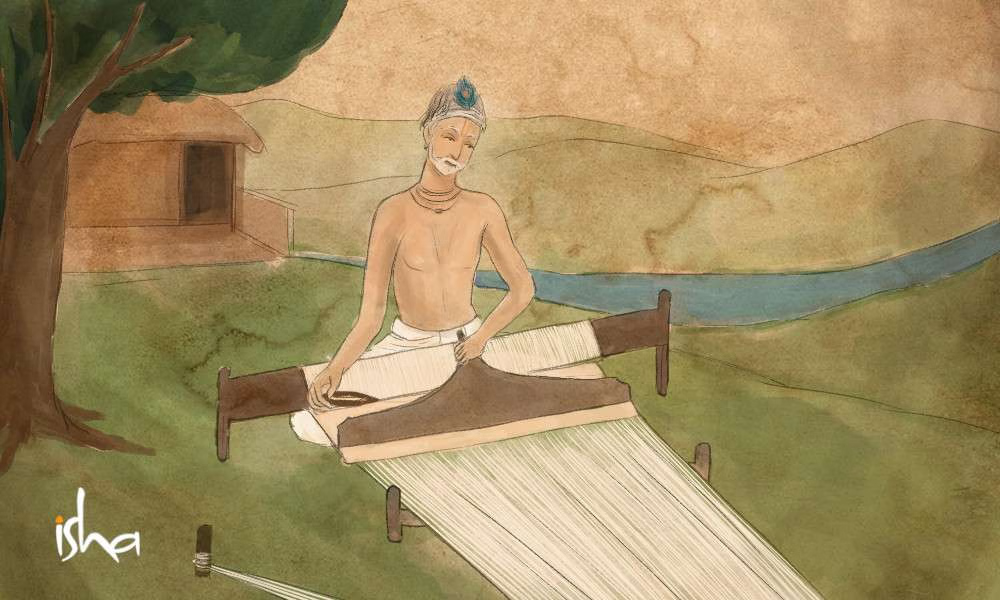
The Dance of Duality: Embracing Oneness in Kabir's Wisdom
In the profound words of Kabir, "The right hand and the left hand are one and the same," we are invited to explore the intricate tapestry of duality and unity that defines our existence. This statement, seemingly simple, resonates deeply within the spiritual landscape, urging us to transcend the apparent divisions that shape our perceptions. The stakes are high: in a world often marked by conflict and separation, understanding this unity can lead to profound peace and a deeper connection with ourselves and others.
As we delve into this quote, we uncover layers of meaning that challenge our conventional understanding of self and other, light and dark, joy and sorrow. Kabir, a luminary of the bhakti tradition, speaks not merely of physical hands but of the dualities that exist within our hearts and minds. This teaching beckons us to recognize that the distinctions we draw are often illusory, and that true wisdom lies in embracing the wholeness of our experience.
The image / the metaphor
The imagery of the right hand and the left hand conjures a vivid picture of duality, where two seemingly opposing forces coexist in harmony. Each hand serves a distinct purpose, yet they are part of the same body, working together in a seamless dance of functionality. The choice of the words "one and the same" emphasizes an intrinsic connection, suggesting that what we perceive as separate is, in essence, unified. This metaphor invites us to examine our own lives, where we often categorize experiences, emotions, and identities into binaries that obscure the underlying oneness.
Diving deeper into this metaphor, we can see how it reflects the broader human experience. Just as our hands perform different tasks, our lives are filled with contrasting experiences—joy and sorrow, love and fear, success and failure. Kabir's wisdom encourages us to embrace these dualities, recognizing that they are not in opposition but rather complementary aspects of a singular reality. This perspective fosters a sense of acceptance and compassion, allowing us to navigate life's complexities with grace.
In the speaker's tradition
Kabir's teachings are rooted in the bhakti tradition, which emphasizes devotion and love as pathways to spiritual realization. Central to this tradition is the concept of unity with the divine, where the individual soul (atman) recognizes its oneness with the universal spirit (Brahman). This understanding resonates with the idea of *fana*, or annihilation of the self, where the ego dissolves into the greater whole. In this context, Kabir's assertion about the right and left hands serves as a reminder that our perceived separateness is an illusion, and that true devotion arises from recognizing our interconnectedness.
Moreover, this teaching aligns with the Buddhist concept of *sunyata*, or emptiness, which posits that all phenomena are interdependent and lack inherent existence. Just as Kabir invites us to see beyond duality, the teachings of *sunyata* encourage us to understand that our identities and experiences are shaped by a web of relationships. In both traditions, the call to transcend duality leads to a profound realization of oneness, urging us to cultivate love and compassion for all beings.
Living the teaching
Consider a modern scenario where this teaching can be applied: in the workplace, we often encounter colleagues with differing opinions and approaches. It is easy to view these differences as obstacles, leading to conflict and division. However, if we embrace Kabir's wisdom, we can recognize that these contrasting perspectives are not adversarial but rather complementary. By fostering a spirit of collaboration and understanding, we can create an environment where diverse ideas contribute to a richer, more innovative outcome.
In personal relationships, the teaching of unity can be particularly transformative. Imagine a moment of disagreement with a loved one, where emotions run high and the urge to defend one's position is strong. Kabir's insight encourages us to step back and see the situation from a broader perspective. Instead of viewing the conflict as a division, we can approach it as an opportunity for growth and deeper connection. By acknowledging the shared humanity in our differences, we can cultivate empathy and understanding, ultimately strengthening our bond.
A reflection
As we contemplate Kabir's profound statement, we are invited to reflect on our own lives: In what ways do we create divisions between ourselves and others? How can we begin to embrace the unity that lies beneath our perceived differences? This inquiry not only deepens our understanding of Kabir's wisdom but also opens the door to a more compassionate and interconnected existence.




Join the BrightStar Community
Stay connected with daily inspiration, event announcements, and community wisdom